


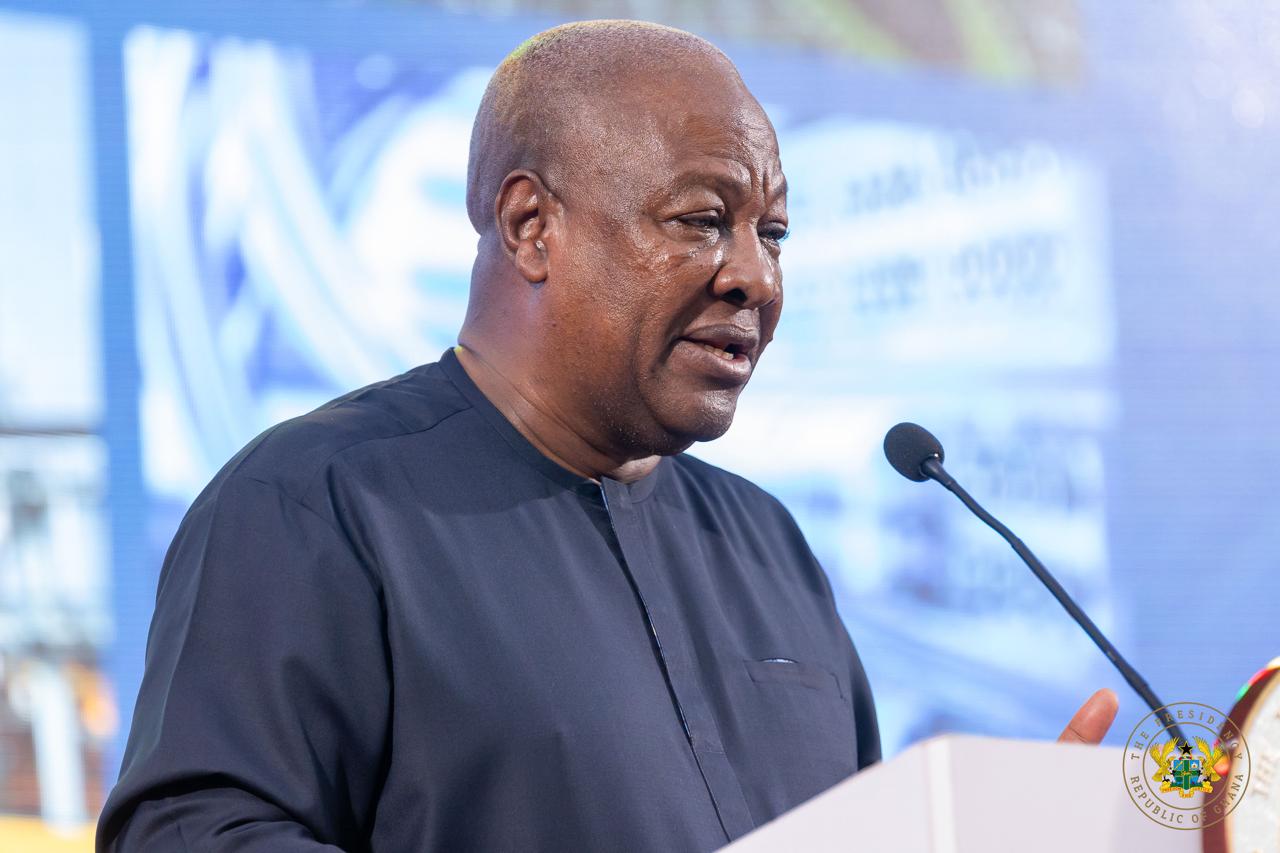
In a bold bid to reshape Ghana’s economic landscape, President John Dramani Mahama has declared that the continuous export of the nation’s minerals in their raw, unprocessed state is “unacceptable” and must end within the next five years.
Speaking at the 2026 Mining Sector Local Content Summit held at Palms by Eagle in Takoradi on Wednesday, February 18, the President outlined a transformative vision to pivot Ghana from a resource-dependent exporter to an industrial powerhouse.
The five-year ultimatum
President Mahama warned that shipping raw ores abroad while simultaneously importing finished mineral products creates an economic deficit that Ghana can no longer afford. He noted that this practice actively deprives the country of vital jobs, revenue, and industrial expansion.
“It is no longer acceptable for Ghana to continue to export raw ores and import finished products,” the President asserted. “We must aim to eliminate the export of raw ores within the next five years. Our mineral wealth must power Ghana’s industrialization and not merely sustain export dependence.”
To achieve this, the President committed to a multi-pronged strategy that comprises: Supporting the establishment of refineries and bullion infrastructure; Promoting mineral-based industrial clusters and; Facilitating downstream processing to retain value within Ghanaian borders.
Legislative reform and local empowerment
Beyond processing, President Mahama revealed that his administration has commenced a comprehensive review of Ghana’s mining laws. The objective is to dismantle regulatory bottlenecks that have historically favored foreign expertise over indigenous growth.
The President emphasized that the government wants to see Ghanaian firms move from the “periphery” to the “center” of the industry—evolving from suppliers of basic consumables to manufacturers of critical machinery and technological solutions.
“We will incentivize mining firms to build local capacity and not simply purchase locally,” Mahama explained. “Equity participation, technology transfer, and knowledge sharing should become standard practice and not the exception.”
A vision for economic sovereignty
The proposed reforms are part of a broader economic transformation agenda targeting the mining, agriculture, and manufacturing sectors. By aligning legal structures with industrial goals, the government aims to ensure that the “Golds” and “Lithiums” of Ghana translate into tangible prosperity for its citizens through job creation and technical expertise.
The President concluded by calling for deliberate policy interventions, including improved financing for local firms and strategic partnerships with global technology providers, to ensure Ghana finally reaps the full rewards of its natural heritage.
