


By Adnan Adams Mohammed
As Ghana navigates its “Golden Reset” in 2026, the spotlight has turned intensely toward the institutions anchoring the nation’s industrial resurgence.
Foremost among these is the Ghana Export-Import Bank (GEXIM), which this week celebrated a decade of existence a milestone marked by record-breaking revenue, radical policy shifts for SMEs, and a poignant reflection on the bank’s foundational vision.
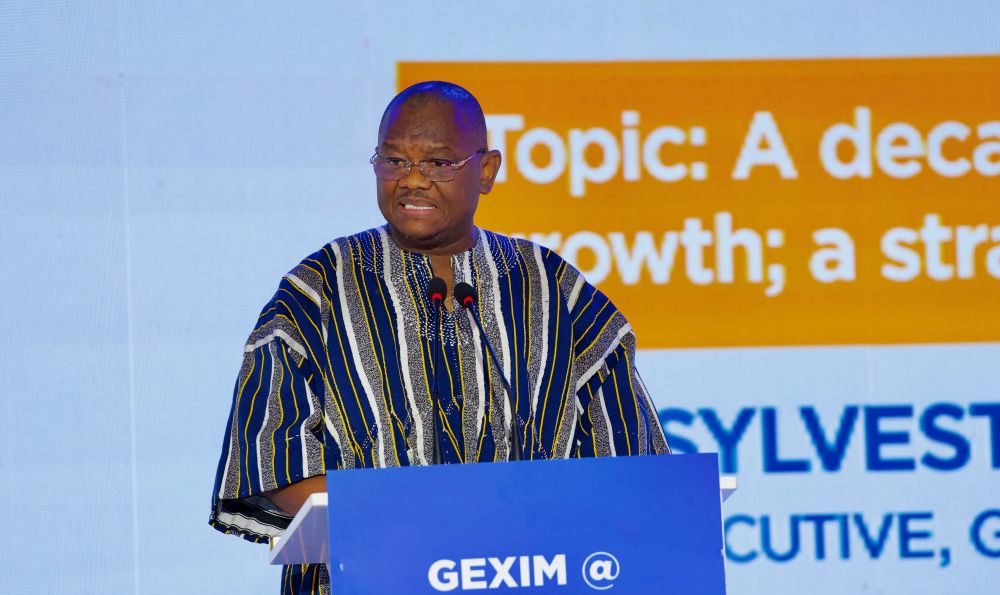
The 10th-anniversary celebrations (GEXIM10) provided a moment of rare political consensus and historical acknowledgement. Delivering the keynote address, the Chief Executive Officer of GEXIM, Sylvester Mensah, took a moment to commend the foresight of President John Dramani Mahama for establishing the bank in 2016.
The CEO noted that the transition from the Export Development and Agricultural Investment Fund (EDAIF) to a fully-fledged EXIM bank was a masterstroke in economic architecture. “The vision was to create a specialized institution that doesn’t just lend, but builds capacity for export,” the CEO remarked. “Ten years later, that vision is the bedrock of our current economic transformation.”
Breaking the collateral barrier
Perhaps the most significant announcement for the business community was a radical shift in GEXIM’s lending policy. Recognizing that many high-potential SMEs are stifled by a lack of landed property, GEXIM has officially reduced loan collateral requirements.
Under the new framework, the bank will move toward “asset-based” and “cash-flow” lending. Instead of demanding traditional titles, GEXIM will now accept moveable assets, purchase orders, and export contracts as primary security. This move is designed to unlock millions of cedis for youth-led startups and women in agriculture who have historically been sidelined by the traditional banking sector.
Fueling the engine: US$71m in import levies
The bank’s ability to take these risks is backed by a formidable balance sheet. In a disclosure that underscores the scale of Ghana’s trade activity, the CEO revealed that the 0.75% import levy the primary funding source for the bank generated a record US$71 million in 2025.
This capital windfall is already being deployed back into the economy. During the forum, GEXIM signed a landmark Memorandum of Understanding (MoU) with five Ghanaian firms in the pharmaceutical, garment, and agro-processing sectors. These agreements are not merely financial; they include technical support to ensure these firms meet the stringent standards required to compete on the global stage.
The AfCFTA frontier
A high-level panel of experts at the forum turned the conversation toward the African Continental Free Trade Area (AfCFTA). With the secretariat headquartered in Accra, the consensus was clear: Ghana must transition from being a host to being a dominant player.
Strategies discussed for export growth included:
Value Addition: Moving away from raw cocoa and gold exports toward processed consumer goods.
Regional Hubs: Utilizing GEXIM funding to establish distribution warehouses in strategic AfCFTA markets like Kenya, Nigeria, and Egypt.
Standardization: Ensuring “Made in Ghana” becomes a global hallmark for quality.
The next decade
As GEXIM enters its second decade, it does so not just as a lender, but as a strategic architect of the “Golden Reset.” By lowering the barriers for SMEs, leveraging its US$71 million levy revenue, and aggressively pursuing the AfCFTA market, the bank is proving that the path to a stable Cedi and a prosperous Ghana is paved with exports.
For the Ghanaian entrepreneur, the message from GEXIM @10 is simple: The era of “collateral frustration” is ending, and the era of global expansion has begun.
