


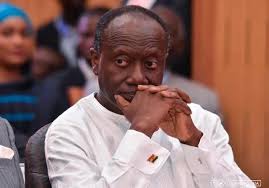
Adnan Adams Mohammed
Many stakeholders have called on the government to reduce drastically the rate of the Electionic Transactions Levy (E-Levy).
The newest voice is the Chief Executive Officer of the Ghana Telecommunications Chamber who wants the rate to be reduced from 1.5% to 0.1%.
Many economists and tech industry players see the introduction of the e-levy at 1.5% as counterproductive to both the government and the development of Ghana’s digital economy. The E-Levy, introduced in the 2022 Budget has performed poorly, raking in just about 10% of the expected revenue three months after its implementation. The levy, which was originally pegged at 1.75% was reduced to 1.5 percent after public agitations against the policy, stakeholders wants the rate reduced further.
“Calling for a total scrap of the tax measure would be insensitive considering the government’s dire need for money amidst an economic turmoil, reducing it to 0.1% would revamp the digital economy thus generating more revenue for government”, Dr. Ken Ashigbey shared during a TV interview last week.
“Our proposition is the fact that, you know, they should scrap it. But we need to be real, government needs money at this particular stage. The deficit position is not good for industry, it affects industry, it’s one of the things that would account for the depreciation of the cedi. The macros would be destabilized.
“So we think that the best thing to do is to reduce the level. Some in the industry have talked about 0.5, but I have said that the best thing to do is to do 0.1.”
Sharing his expectations, the Director of the Institute of Statistical, Social and Economic Research (ISSER) of the University of Ghana advised government to use the 2023 Budget as a big opportunity to correct the policy by reducing the rate significantly to encourage the public to pay the tax.
He maintained that the budget gives government a unique chance to rebuild confidence in Ghanaians, by listening to the public through a reduction in the e-levy.
“E-levy can be made better. It can be made more efficient. Let us reduce the rate to 0.5% and I am sure we can raise a lot of revenue,” Prof. Peter Quartey has said in Accra, last week, during a pre-budget discussion.
Also, the President of the Association of Ghana Industries (AGI), Dr. Humphrey Ayim-Darke also called for a reduction of E-levy to cushion the operations of businesses.
He stated that the levy in its current state imposes extra burden on businesses, already struggling with the current economic conditions in the country.
“The E-levy must be reduced”, he said, explaining that businesses and consumers will always find legal means to avoid taxes if it increases their economic hardship.
“We think one place that can be improved is the VAT system. We must block the loopholes in our VAT system and not introduce new taxes like e-levy that is not working” he said.
Dr. Ayim-Darke also called on the Finance Minister to reduce taxes on raw materials for industry.
He stated that such a policy will strengthen the operations of local industries to be globally competitive.
Dr. Ken Ashigbey added that, while the government reduces the rate, they should also place a cap on it.
He explained that, transactions that are 5,000 cedis and above should only attract a fixed e-levy rate to attract more large transactions on mobile money platforms.
According to him, the current cap-less system makes it most undesirable to transact business with large sums of money via digital platforms.
“You know, push the level down to 0.1 and then put a cap on it. Say 5,000 cedis. At 5,000 cedis the levy is fixed so that if anybody wants to send 10,000 cedis, you know, that will happen,” he said.
“Take out the discrimination between the 20,000 that you give to the banks and then you give to mobile money so that the discrimination is not based on that,” he added
On the other hand, Dr. Ashigbey is calling on the government to place a cap on the amount of cash that can be used in a transaction.
According to him, when physical transactions are capped at 2,000 cedis for instance, people will be forced to transact business via mobile money platforms for large transactions.
“Another innovative thing that we would say is that put a cap on any transaction that can be done by cash, so let’s say 2,000 cedis. If you want to do any transaction above 2,000 cedis use a digital means for mobile money, for the banks and all of that.
“What will happen is that a lot of the things that happen underground… a lot of that you’ll be able to take them off and then you’ll be able to see a lot of movement in terms of cash and that also will help,” he said.
“And then in terms of government payments, make sure that all government payments mandatorily are made simple and let people be able to pay so that tolls that people pay in the market and all that will use these digital means. And if you’re going to do that make sure that it is seamless, it’s not difficult to do,” he added.
Giving some more recommendations, Prof. Quartey stated that government can improve tax collection by bringing back road toll to improve revenue mobilisation.
He pointed out that road toll is one of the most effective ways to collect and account for taxes.
“I think that we can properly digitise road tolls through public-private partnership to make the collection of taxes effective. I think government must consider bringing the road tolls back”, he said.
