


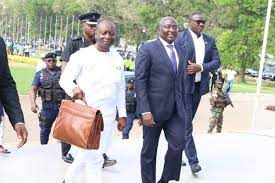
Adnan Adams Mohammed
The government’s dream of accessing the international financial market soon could be a mirage as the International Monetary Fund has shot-down hopes that successful debt restructuring will automatically regain Ghana access to borrow.
The Fund in its Staff Report indicated that, after Ghana’s success with the debt restructuring, there will also be a need to restore market confidence in the sustainability of Ghana’s economic policies, which requires significant fiscal adjustment amid political challenges.
This follows President Nana Addo Dankwa Akufo-Addo comment made at the Qatar-Africa Economic Forum in Doha, last week, disclosing his government’s plans to return to the international market to borrow to fund critical infrastructural projects following the successful completion of Ghana’s US$3 billion deal with the International Monetary Fund (IMF). I
He indicated that, even though his government is not in a rush to return to the international market, it makes sense to take advantage of the market now and make some savings.
“We have positioned ourselves to be able to go back into the international market which had been a source of funding for us during the first three or four years of our government,” the president said. “There is no rush but obviously why not take advantage of global savings? It makes a lot of sense to me.
“We will try as much as possible to maintain the discipline which is required and the most important requisite for a successful programme.”
However, the Fund has noted that, risks to regaining sufficient market access are also very high.
“High prospective debt service to the Fund after the end of the programme may itself make it more difficult to regain market access. Strong programme commitment and ownership by the authorities and continuous engagement with them and their advisors before and following the programme approval could help mitigate these risks”, it explained.
Ghana has been closed to accessing the international capital market since 2022 due to its debt distress situation.
Meanwhile, the IMF had said that Ghana’s capacity to repay its $3 billion Extended Credit Facility is adequate—assuming successful programme and debt restructuring implementation and provided adequate market access is eventually restored.
However, it is subject to substantial downside risks.
Under the baseline, which does not reflect debt restructuring, it said, several capacity-to-repay indicators are consistently above the top quartile of past Upper Credit Tranche (UCT)-quality arrangements for PRGT programmes.
It mentioned that “outstanding credit is projected to peak at 5.3% of Gross Domestic Product (407% of quota) in 2026, and then gradually converge towards the top quartile of past Poverty Reduction and Growth Trust (PRGT) arrangements over the next 10 years. Capacity to repay is further constrained by Ghana’s low level of reserves”.
At the start of the programme, Fund credit outstanding is at 161% of gross international reserves and remains close to 50% of reserves by the end of the programme.
