


Adnan Adams Mohammed
The International Monetary Fund (IMF) has expressed satisfactory of Ghana’s programme during the first review and has assured disbursement of second tranche of US$600m disbursement in November.
The Fund noted a significant improvement in the country’s economic recovery programme over the past month.
Ghana, concluded a Balance of Payment Support of a US$3 billion from IMF in May this year. The debt distressed country is currently undergoing its first programme review, expected to be conclude in November. But, the Managing Director of the Fund in an interview last week noted that, Ghana, which has defaulted on its debt, is making progress under their IMF programme.
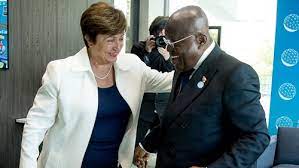
“Ghana is doing actually quite well. You have seen that their position has improved over the last month, the economy is in a much better place”, Kristalina Georgieva has said. “I would very much hope that we can have the disbursement,” she said referring to a $600 million tranche of IMF money that’s due to be disbursed in November.
“That is part of the confidence building that we are projecting,” she said regarding Ghana’s economic stability.
In her broader remarks, Georgieva identified addressing unsustainable debt crises as a “top priority”.
She defended the G20 Common Framework for debt treatment, despite criticism for its perceived slow pace in providing relief to applicants.
Georgieva pointed out that as more nations seek assistance, the process is becoming more efficient, with Chad, Zambia, Sri Lanka, and Ghana demonstrating shorter timeframes for progress.
Chad took 11 months between an initial staff level agreement to financial assurances, Zambia nine months, Sri Lanka six months and Ghana five months, she said.
“I hear lots of people saying, oh this doesn’t work,” she said.
“My question to them is, ok, you forget about it. What do you have instead?”
Meanwhile, the Fund noted that, Tunisia doesn’t need a restructuring yet but should act soon to shore up its economy.
Also, the IMF boss said Egypt will “bleed” precious reserves unless it devalues its currency again, as she praised other steps her institution’s second-largest borrower has taken to right its stricken economy.
Egypt’s devalued the pound three times since early 2022, with the currency losing almost half its value against the dollar.
Georgieva said it’s delaying the inevitable by holding off from doing so again and the longer it waits, the worse it will get.
“The sooner we can reach an agreement on the road map for this the better,” she said.
“The issue here is very simple. Egypt would bleed reserves protecting the pound and neither the country nor overall the environment is such that this is desirable. That’s a problem that has to be solved.”
Egypt’s net international reserves last year fell to the lowest level since 2017 before stabilizing in recent months to reach $35 billion in September — still down by more than a fifth since their 2020 high.
