


By Adnan Adams Mohammed
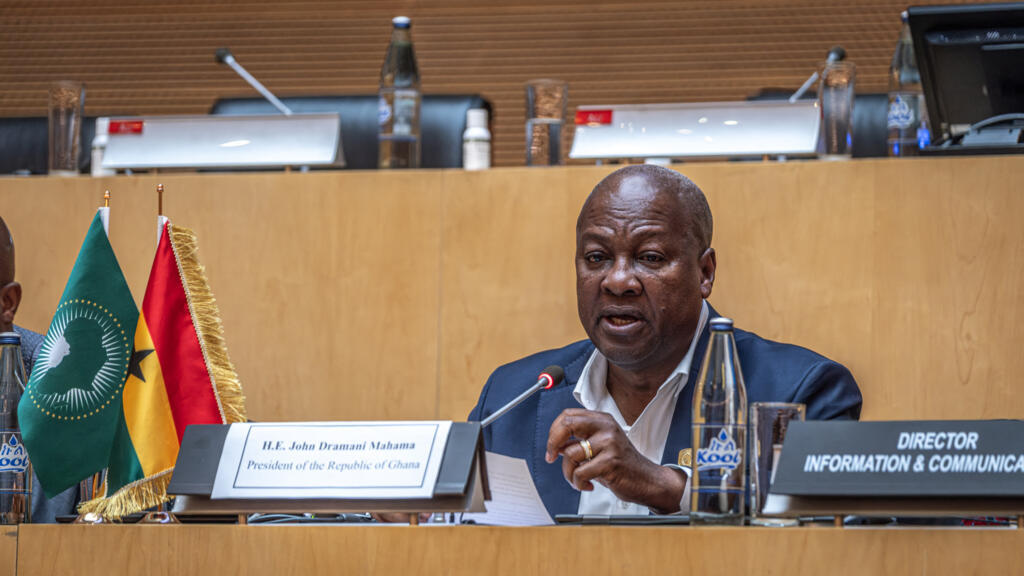
President John Dramani Mahama has called for a unified African position on the legacy of slavery and racialized chattel enslavement, describing it as “the gravest crime against humanity.”
He made the remarks during a high-profile press conference at the 39th African Union (AU) Summit on Sunday, February 15, where he serves as the AU Champion for Reparations.
Addressing journalists, President Mahama stressed that slavery is prohibited under international law as a peremptory norm—a fundamental principle from which no derogation is permitted. He explained that Ghana’s proposed resolution, which is set to be tabled at the UN General Assembly in March 2026, is anchored on three key pillars:
Historical Accuracy; Legal Defensibility; and Continental and Diaspora Alignment.
“Our approach ensures that the text of this resolution reflects rigorous scholarship, moral clarity, and diplomatic credibility,” he said, noting that Ghana had undertaken extensive consultations with bodies like UNESCO, the Pan-African Lawyers Union, and the AU Committee of Experts on Reparations to strengthen the proposal.
Redefining the Crime
Following expert input, the title of the resolution has been refined to: “Declaration of the Trafficking in Enslaved Africans and Racialised Chattel Enslavement of Africans as the Gravest Crime Against Humanity.”
President Mahama noted that the wording was deliberately precise to acknowledge:
● The systematic trafficking of over 12.5 million Africans.
● The institutionalized nature of racialized chattel enslavement.
● The enduring consequences, including structural inequality and economic imbalances.
“The resolution is not just symbolic,” he stressed. “It provides a legal and moral foundation for reparatory justice, African unity, and engagement with the global community on historical injustices that continue to shape our societies.”
The Decade of Reparations
The President’s call aligns with the AU’s recent decision to extend its theme on reparations into a full Decade of Reparations (2026–2036). He urged fellow heads of state to “choose courage over comfort” and support the movement, which seeks not just financial compensation but formal acknowledgment and policy reforms to address the $100 trillion loss in human and material resources estimated by scholars.
“All peoples of African descent have been waiting for this day. The truth cannot be buried,” Mahama concluded.
