


By Adnan Adams Mohammed
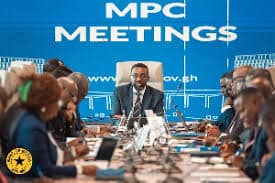
The Bank of Ghana’s Monetary Policy Committee (MPC) will be holding its 129th regular meeting this week with a difficult riddle to solve. Should it reward the economy with a rate cut after hitting a stellar inflation target, or hold firm against a gathering storm of global “war shocks”?
New data reveals that Ghana’s year-on-year inflation plummeted to 3.3% in February 2026, a drastic fall from the 23.1% recorded just a year ago. This puts inflation not only within but significantly below the central bank’s medium-term target band of 8+- 2%.
PwC’s “Support Growth” Stance
Professional services firm PwC argues that the data strongly supports a reduction in the Monetary Policy Rate (MPR) when the committee meets on March 18. According to PwC, the current stability provides a “strong justification” to ease borrowing costs and stimulate credit to the private sector.
PwC highlights four pillars for a rate cut:
Anchored Inflation: At 3.3%, headline inflation is firmly under control.
External Stability: Imported inflation has dropped to 0.6%, suggesting the cedi is holding its own.
Broad-based Easing: Both food and non-food categories are showing sustained stability.
Policy Maturity: The firm argues that previous tightening measures have already done their job.
“The data strongly supports a measured reduction… to stimulate credit, ease borrowing costs, and reinforce the macroeconomic recovery,” PwC stated in its commentary.
The Case for a Hold
However, prominent economist Professor Peter Quartey is urging the BoG to exercise extreme caution. Despite the positive local data, he warns that the escalating US-Israel-Iran conflict could trigger a “supply-side shock” that would make a rate cut premature.
Prof. Quartey, former Director of ISSER, believes the Bank should maintain the rate at its current 15.50%.
“I think they will be minded by what is happening in the Gulf,” Prof. Quartey remarked. “It is better they maintain their rates now and look at what happens in the immediate future.”
Global vs. Local: The MPC’s Dilemma
The MPC must now weigh two conflicting realities:
PwC also identified emerging risks that could pause a rate cut. These include disruptions to regional trade in the Sahel due to terrorist activity, which could spike food prices, and the risk of the Middle East conflict pushing energy costs back into the double digits.
Furthermore, with the National Petroleum Authority (NPA) already hiking fuel price floors for the second half of March, the “disinflationary trend” the country has enjoyed could be under threat as early as next week.
As Governor Dr. Johnson Asiama and the committee prepare to sit from March 16 to 18, the business community remains divided. Will the BoG prioritize the immediate relief of a rate cut, or will the fear of a global oil-led inflation rebound keep the status quo in place?
