


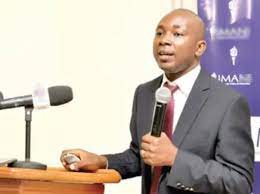
Adnan Adams Mohammed
Economist with the University of Ghana Business School has expressed worry about the current structure of the International Monetary Fund (IMF) -support programme for Ghana over the next three years.
He believes the prescribed solutions to Ghana’s economic challenge under the programme, which is largely driven by revenue mobilisation, were not properly crafted.
Indicating that, Ghana’s problem is not about revenue mobilisation but rather expenditure. The expenditure, he said, is characterised by numerous wastages and corrupt practices. The way to go is for government to adopt a lean government, exhibit efficiency and ensure higher value for money at all times, similar to the practices of Singapore and Malaysia.
“I have a problem with the design of the programme. By the time we are done, it will leave more Ghanaians vulnerable than it sought to achieve”, Professor Godfred Bokpin said in an interview last week. “Given that we are not generating sufficient domestic revenue and that it is not the entire problem. And I’ve said before that if you look at the tax-to-GDP ratio of Malaysia and Singapore, really it has been almost below 15%.”
“At some point in time, Ghana’s tax-to-GDP ratio was higher than Malaysia and Singapore. So you can see that Malaysia and Singapore have developed from lean government and efficiency and higher value for money”, he added.
Professor Bokpin outlined further that though he encourages the government to do more in revenue management, it must also be mindful of the wastage in the system.
“In as much as we’re encouraging government, that is why I have a bit of a problem with the IMF programme that once your diagnosis of the problem is that we don’t have a lot of revenue, that is why we run into these challenges. Then the solution would also be heavily revenue based”.
A careful look at the IMF Staff Report on Ghana indicate that a lot of way forward for the economy hinged on revenue enhancement.
An example, the IMF said its Staff supported the government’s preference for a fiscal strategy based on a significant revenue increase. This is given Ghana’s low revenue-to-GDP ratio and the need to create space for higher development spending over the medium term, the authorities
He explained that even though Ghana’s tax-to-GDP is not the best, improving revenue collection without blocking the loopholes that encourage corruption will yield little results.
“In as much as a spoiled child needs money, that spoiled child needs more discipline and measures to tackle corruption”, he said, adding that increasing revenue without proper measures to ensure its efficient usage will be counterproductive.
Prof. Bokpin is of the view that for a developing country with revenue leakage challenges, the programme should have outlined strict measures that will be disincentive acts of corruption.
“I have gone through the programme. The programme is largely mute on corruption measures. The programme is largely mute on wasteful expenditure cut. The programme is heavily based on revenue based fiscal consolidation. I think by design, it is an error”.
He stressed that it will be in the interest of the country to self-impose anti-graft measures to stop wastage in the public sector.
Already, the Ghana National Chamber of Commerce and Industry (GNCCI) earlier expressed worry about the revenue mobilisation under its $3 billion IMF support programme.
According to the Chamber, if the suggestions are implemented, it will adversely affect businesses that are already burdened with numerous taxes and other unfavourable conditions.
The Chief Executive Officer of the Chamber, Mark Badu-Aboagye indicated that at present, the country is undergoing some level of economic crisis.
“Businesses in Ghana are very ready. I told you, the last time that we conducted a research, we realised that the SMEs in Ghana are growth-oriented, which means that by giving them the opportunity they can grow to become multinationals.
However, he pointed out that, “When you introduce externalities like taxes, like high-interest rates, like levies, then you go to the bottom line and you realise that all of them are making losses, which means that, that component needs to be managed”, he said.
