


By Adnan Adams Mohammed
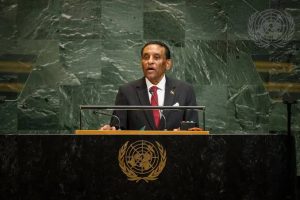
New York, USA — In a powerful address delivered before the United Nations Security Council on December 22, 2025, H.E. Dr. Kamil El-Tayeb Idris, Prime Minister of the Republic ofI the Sudan, presented a decisive, Sudanese-led initiative aimed at ending the nation’s devastating civil war.
Facing an existential crisis and an “unbearable price in human lives,” Prime Minister Idris called for a global partnership to replace chaos with order and secure a just future for the Sudanese people.
The Prime Minister framed the “Government of Sudan Peace Initiative” not as an illusion of victory, but as a responsible choice to stop the bloodshed, protect civilians, and restore state authority. This framework, he noted, is designed to complement and build synergy with the existing American-Saudi Initiative.
“Today, Sudan does not ask for sheer sympathy, it asks for partnership in securing peace, justice and dignity for its people,” H.E. Dr. Idris stated.
A Roadmap for Recovery
The initiative, detailed within the address, outlines a pragmatic, phased approach grounded in international principles and national ownership.
Key components include:
Immediate Ceasefire and Withdrawal: The plan demands a comprehensive ceasefire, supervised jointly by the United Nations, the African Union, and the League of Arab States. This crucial first step mandates the withdrawal of the rebel militia (formerly the Rapid Support Forces) from all occupied areas, consistent with the May 11, 2023 Jeddah Declaration of Principles signed by both parties.
DDR and Accountability: The initiative emphasizes practical security measures, including gathering, registering, and screening militia fighters in designated camps. This process sets the stage for comprehensive Disarmament, Demobilisation, and Reintegration (DDR) programs for those eligible to return to civilian life or integrate into Sudan’s reformed, regular forces.
Prime Minister Idris stressed that peace must include accountability. The plan carefully balances transitional justice for perpetrators of war crimes, genocide, and human rights violations with policies to regularize the status and ensure the rights of those not involved in atrocities.
Humanitarian Access and Reconstruction: Addressing the unprecedented humanitarian disaster, the plan prioritizes the safe return of displaced persons and refugees and guarantees the unhindered flow of aid. Furthermore, it pledges the allocation of national and international resources for reconstruction projects in war-affected states like Darfur and Kordofan, supported by microfinance funds to stimulate economic recovery.
The Path Forward
Beyond immediate security concerns, the initiative provides a clear blueprint for Sudan’s political future. It mandates community reconciliation conferences to mend the social fabric, followed by a comprehensive Sudanese-Sudanese dialogue to manage the transitional period.
The ultimate goal remains free and fair elections under international supervision to complete the democraticu transition.
“History will not remember how complex this conflict was; it will remember whether the world acted when action was possible,” Prime Minister Idris urged the Council members.
By seeking the Security Council’s undivided attention and full support, the Government of Sudan has presented a viable pathway for the international community to move from being a witness to the nation’s collapse to an active partner in its recovery.
